The Mercedes-Benz W126
Posted by Harold Freeman on Jan 27th 2026

My Account
If you are already registered, please log in.
Create your account and enjoy a new shopping experience.
Create A New AccountPosted by Harold Freeman on Jan 27th 2026
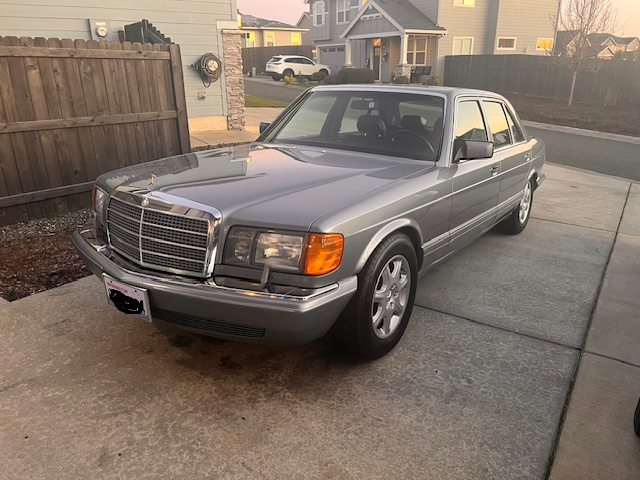
The Car That Redefined Luxury Forever Few automobiles in history have achieved what the Mercedes-Benz W126 accomplished. Launched at the end of the 1970s and produced until 1991, the W126 S-Class did more than replace its predecessor — it redefined what a luxury automobile could be. It was not merely a flagship sedan; it was a rolling statement of engineering philosophy, social status, and timeless design. More than four decades later, the W126 remains one of the most respected luxury cars ever built. Revered for its durability, elegance, and engineering integrity, it stands as a benchmark that modern luxury cars are still measured against. This is the story of how the W126 became one of the greatest automobiles of all time. A New Era Begins When Mercedes-Benz began development of the W126 in the early 1970s, the world was changing rapidly. The oil crisis loomed, safety regulations were tightening, and customers expected more refinement than ever before. The outgoing W116 S-Class had been revolutionary — it introduced the S-Class name itself — but Mercedes knew the next model had to be smarter, lighter, safer, and more efficient. The challenge was enormous. Mercedes engineers were tasked with creating a luxury sedan that offered: Improved fuel efficiency Advanced safety systems Reduced weight Lower aerodynamic drag Better performance Increased comfort All without compromising the brand’s reputation for longevity and prestige. The result was the W126, unveiled in 1979. Design: Timeless, Not Trendy One reason the W126 has aged so gracefully lies in its design philosophy. Rather than chasing trends, Mercedes focused on function-led elegance. Designed under the direction of legendary stylist Bruno Sacco, the W126 introduced a cleaner, more aerodynamic shape that subtly modernized the classic Mercedes look. Key design features included: Smooth, restrained body lines Flush glass surfaces Integrated bumpers A noticeably lower drag coefficient than its predecessor A wider stance with excellent proportions Unlike many luxury cars of the era, the W126 avoided excess chrome and visual clutter. Everything had purpose. Even today, the car looks dignified rather than dated — a rare achievement in automotive design. Bruno Sacco famously said that Mercedes cars should “never make the previous model look old,” and the W126 embodied that philosophy perfectly. Two Bodies, One Identity The W126 was offered in two primary body styles: Short-Wheelbase (SE/SEL) More agile Popular in Europe Favored by private owners Long-Wheelbase (SEL) Extended rear legroom Preferred by executives and chauffeurs Became synonymous with political and corporate power Later, Mercedes introduced something entirely unexpected. The SEC Coupe In 1981, the W126 family expanded with the SEC pillarless coupe, widely regarded as one of the most beautiful grand tourers ever made. With frameless doors, an elongated hood, and a sweeping roofline, the SEC blended luxury with sportiness in a way few cars had before. Today, models like the 560 SEC are among the most collectible Mercedes vehicles in existence. Engineering Excellence Mercedes-Benz has always prioritized engineering over marketing, and the W126 was a showcase of that mindset. Lightweight Construction Despite being larger than the W116, the W126 was actually lighter thanks to: High-strength steel alloys Optimized structural design Reduced unnecessary mass This resulted in improved fuel economy and performance — essential during a time of global fuel concerns. Safety: Years Ahead of Its Time Perhaps the W126’s greatest legacy lies in safety innovation. Mercedes did not simply respond to regulations — it set them. Major safety advancements included: Standard ABS braking (a world first in many markets) Driver airbag (introduced in 1981) Passenger airbag (introduced in 1987) Seatbelt pretensioners Reinforced passenger cell Engineered crumple zones At a time when airbags were considered experimental, Mercedes made them available in a production luxury sedan — years before most competitors. The W126 quickly became the safest car in the world, a reputation it maintained throughout its production run. Engines: Smooth Power, Built to Last The W126 offered one of the widest engine ranges of any luxury car ever produced. Inline-Six Engines 2.6L and 2.8L variants Exceptionally smooth Known for extreme longevity Capable of exceeding 300,000 miles with proper maintenance V8 Engines 3.8L 4.2L 5.0L 5.6L (the legendary M117) The flagship 560 SEL and 560 SEC produced up to 300 horsepower in European specification — remarkable for the era. These engines were not designed for maximum output but for effortless cruising, quiet operation, and long service life. Many remain on the road today with original drivetrains. Transmission and Ride Quality Most W126 models were equipped with: 4-speed automatic transmissions known for near-indestructibility Select manual gearboxes in certain markets The ride quality struck a near-perfect balance between comfort and control. Independent suspension at all four corners, precise steering, and exceptional high-speed stability made the W126 one of the best long-distance cruisers ever produced. At 100 mph on the Autobahn, the car felt calm, planted, and unstrained — exactly as Mercedes intended. Interior: Built Like a Vault Step inside a W126, and the difference between modern luxury and traditional craftsmanship becomes immediately clear. Instead of screens and ambient lighting, you are greeted with: Thick Zebrano wood trim Dense sound insulation Over-engineered switchgear Seats designed for all-day comfort Clear, logical instrumentation Every button moves with resistance. Every door closes with a solid, reassuring “thunk.” The materials were chosen not for appearance alone, but for durability. Many interiors remain intact after four decades — a testament to Mercedes’ obsession with quality. The Car of Power and Prestige During the 1980s, the W126 became the definitive symbol of success. It was the preferred transport of: Heads of state CEOs Diplomats Celebrities Financial elites From Wall Street to Hollywood, from European capitals to Middle Eastern palaces, the W126 projected authority without flashiness. It didn’t need to shout. Its presence spoke quietly — and confidently. Motorsport and Cultural Impact While not a racing car in the traditional sense, the W126 platform gave rise to one of the most legendary tuner collaborations in automotive history. AMG Before Mercedes Ownership Before becoming part of Mercedes-Benz, AMG transformed the W126 into brutal high-performance sedans and coupes. The most famous example: The AMG 6.0 “Hammer” Hand-built DOHC V8 Over 375 horsepower Capable of 190+ mph Faster than many supercars of its time The Hammer cemented the W126’s place in performance folklore and helped establish AMG as a global icon. Unmatched Reliability Perhaps the most remarkable achievement of the W126 is its durability. These cars were engineered with: Conservative tolerances Oversized components Redundant systems Extensive real-world testing Mercedes famously tested prototypes for millions of miles under extreme conditions. As a result, the W126 earned a reputation for running seemingly forever. Taxi companies used them. Governments relied on them. Families passed them down generations. Few vehicles before or since have matched this level of reliability in a luxury platform. The End of an Era Production of the W126 ended in 1991 after over 890,000 units, making it the best-selling S-Class generation in history. Its successor, the W140, introduced groundbreaking technology — but also marked a shift toward complexity, weight, and cost. Many enthusiasts consider the W126 the final Mercedes built under the philosophy of: “Engineered without compromise.” Why the W126 Still Matters Today In today’s world of digital dashboards, subscription features, and disposable electronics, the W126 stands as a reminder of a different automotive age. An age when: Engineers ruled over accountants Durability mattered more than profit margins Longevity was expected, not optional Luxury meant craftsmanship, not software This is why values of clean W126 examples continue to rise. Collectors seek them. Drivers cherish them. Mechanics respect them. Ownership in the Modern Era Owning a W126 today is surprisingly attainable. Advantages include: Strong parts availability Excellent documentation Active enthusiast communities Proven mechanical reliability Challenges include: Aging rubber components Fuel system maintenance Climate control complexity Rust in neglected examples But when properly maintained, a W126 remains fully capable of daily driving — even by modern standards. A Legacy Cast in Steel The Mercedes-Benz W126 is not simply a classic car. It is a monument to engineering discipline. It represents a moment in time when Mercedes-Benz built automobiles not to satisfy shareholders, but to set standards for the entire industry. That philosophy produced a car so well engineered that decades later, it still feels solid, relevant, and dignified. Few vehicles can make that claim. Conclusion: The Greatest S-Class Ever Built Ask enthusiasts, collectors, and longtime Mercedes technicians which S-Class was the best, and the answer is remarkably consistent. The W126. Not because it is the fastest. Not because it is the most technologically advanced. But because it achieved something far more difficult: perfection through balance. Comfort, safety, durability, performance, and elegance — all harmonized into one extraordinary automobile. The Mercedes-Benz W126 was not designed to impress for a moment. It was designed to last a lifetime. And it did.